Three Days and Three Nights: Christ’s Journey from Gethsemane to the Resurrection
UGA Media Bible Study | Thursday, 22 October 2026
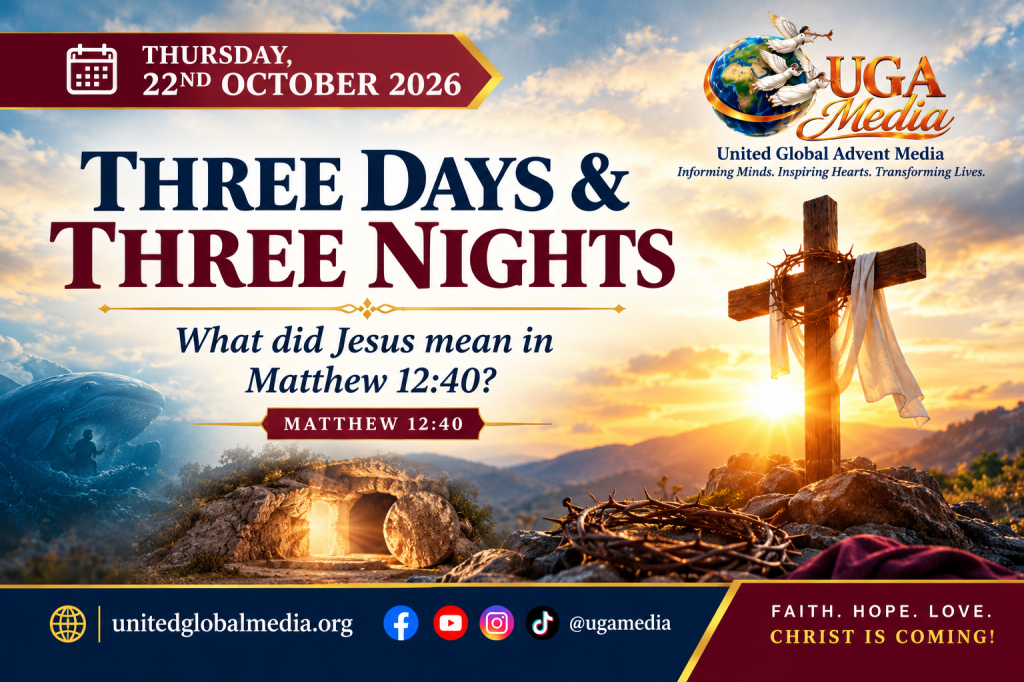
Key Scripture: Matthew 12:40 (KJV)
“For as Jonas was three days and three nights in the whale’s belly; so shall the Son of man be three days and three nights in the heart of the earth.”
What Did Jesus Mean by “Three Days and Three Nights”?
In Matthew 12:40, Jesus compared His coming experience to Jonah’s three days and three nights in the belly of the great fish. While this statement is commonly understood as referring to the time Jesus’ body remained in the tomb, the study Three Days & Three Nights presents a different interpretation. It maintains that Christ’s experience in the heart of the earth began before His crucifixion and included the spiritual suffering He endured as He bore the burden of humanity’s sin.
Jonah’s Experience as a Symbol
The study begins with Jonah 1:17 and Jonah 2:1. Jonah was swallowed by a great fish and, in his distress, prayed to God from within it. Although his situation appeared hopeless, he turned to the Lord. After three days and three nights, God caused the fish to release him, and Jonah was given another opportunity to fulfil his mission (Jonah 2:10–3:2).
The document uses Jonah’s experience as a representation of Christ’s own ordeal. It focuses not merely on the physical location of Jonah or the fish, but on the distress, prayer, and submission that characterised his experience.
Christ’s Suffering Began in Gethsemane
The study then traces Jesus’ path from the Last Supper to Gethsemane, through the trials, the crucifixion, and finally the resurrection.
In Matthew 26:38–39, Jesus expressed profound sorrow and prayed for the cup before Him to pass, yet He submitted to the Father’s will. According to the document, this moment in Gethsemane marks the beginning of the period it identifies with Christ being in the “heart of the earth.”
The author argues that Jesus’ suffering was more than physical pain. It involved the dreadful burden of sin and the experience of separation from His Father, which the study associates with divine judgment. Jesus remained in willing submission through His arrest, trials, and crucifixion.
How the Study Counts the Three Days and Three Nights
The document presents the following chronology to explain its interpretation:
- First night and day: Friday night, beginning with Jesus’ experience in Gethsemane, and the Friday daylight period.
- Second night and day: The Sabbath night and Sabbath daylight period, during which Jesus’ body remained in the tomb.
- Third night and day: The night following the Sabbath and the early daylight hours of the first day of the week, when Jesus rose from the dead.
The author uses the resurrection accounts in Matthew 28:1, Mark 16:2, Luke 24:1, and John 20:1 to support the conclusion that Jesus rose on the first day of the week.
Thus, the document’s central conclusion is that the expression “three days and three nights in the heart of the earth” encompasses Christ’s spiritual suffering beginning in Gethsemane, His death and burial, and His resurrection. It does not restrict the expression solely to the time His body lay in the tomb.
Reflect on the Meaning of Christ’s Sacrifice
This study invites readers to look more deeply at the suffering of Jesus and the significance of His complete surrender to the Father. Gethsemane reveals His anguish, the cross reveals the cost of His mission, and the resurrection proclaims His victory.
Understanding the study’s interpretation requires examining the Bible passages together and carefully following the chronology and reasoning presented by the author.
Continue Reading: Download the Full Bible Study
This article provides a summary of the main argument in “Three Days & Three Nights.” The full PDF develops the interpretation in greater detail, tracing the author’s reasoning through the story of Jonah, Jesus’ experience in Gethsemane, His crucifixion, and the resurrection accounts.
Download the full PDF to read the complete study, examine the supporting Scriptures, and follow the detailed explanation of how the author understands the three days and three nights.
Read the passages for yourself, reflect on the message, and continue growing in your understanding of Christ’s sacrifice.
UGA Media — Informing Minds. Inspiring Hearts. Transforming Lives.
Visit unitedglobaladventmedia.org for more Bible studies, devotionals, and resources for spiritual growth.


Leave a Reply